
Olivia de Havilland, star of Gone with the Wind, Robin Hood, Captain Blood and 47 other films, died Sunday at age 104. You can see an all–day film tribute to her on August 23.
De Havilland was born July 1, 1916, in Tokyo to British parents; her younger sister was movie star Joan Fontaine, who died in 2013 at age 96.
A tribute to is planned by Turner Classic Movies for August 23, 2020 with the broadcast of 11 of her films, including Robin Hood and Gone With The Wind. See details at: TCM Tribute to Olivia de Havilland
Here is a tribute to de Havilland from Turner Classic Movies.

About Olivia de Havilland (from Wikipedia)
Dame Olivia Mary de Havilland DBE (/də ˈhævɪlənd/; July 1, 1916 – July 26, 2020) was a British-American actress. The major works of her cinematic career spanned from 1935 to 1988. She appeared in 49 feature films, and was one of the leading actresses of her time. She was the last major surviving star from the Golden Age of Hollywood Cinema and oldest living Academy Award winner, until her death in July 2020. Her younger sister was actress Joan Fontaine.
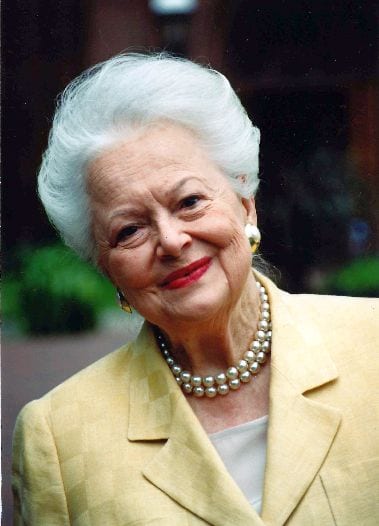
De Havilland first came to prominence by forming a screen couple with Errol Flynn in adventure films such as Captain Blood (1935) and The Adventures of Robin Hood (1938). One of her best-known roles is that of Melanie Hamilton in the classic film Gone with the Wind (1939), for which she received her first of five Oscar nominations, the only one for Best Supporting Actress.
De Havilland departed from ingénue roles in the 1940s and later received acclaim for her performances in Hold Back the Dawn (1941), To Each His Own (1946), The Snake Pit (1948), and The Heiress (1949), receiving nominations for Best Actress for each, winning for To Each His Own and The Heiress. She was also successful in work on stage and television. De Havilland lived in Paris from the 1950s, and received honours such as the National Medal of the Arts, the Légion d’honneur, and the appointment to Dame Commander of the Order of the British Empire.
Olivia De Havilland’s mother, Lilian Fontaine (née Ruse; 1886–1975), was educated at the Royal Academy of Dramatic Art in London and became a stage actress. Her father, Walter de Havilland (1872–1968), served as an English professor at the Imperial University in Tokyo before becoming a patent attorney.
Olivia Mary de Havilland was born on July 1, 1916. They moved into a large house in Tokyo, where Lilian gave informal singing recitals. Olivia’s younger sister Joan (Joan de Beauvoir de Havilland)—later known as actress Joan Fontaine—was born 15 months later, on October 22, 1917. Both sisters became citizens of the United Kingdom automatically by birthright.
Early films, 1935–1937
De Havilland made her screen debut in A Midsummer Night’s Dream (1935). While the critical response was mixed, de Havilland’s performance was praised by The San Francisco Examiner critic. In his review in the Brooklyn Daily Eagle, Winston Burdett wrote that she “acts graciously and does greater justice to Shakespeare’s language than anyone else in the cast”. Minor comedies followed, with De Havilland playing the sweet and charming love interest—a role into which she would later become typecast.
In the film, she played Arabella Bishop, the niece of a Jamaica plantation owner, who purchases at auction an Irish physician wrongly condemned to servitude. The on-screen chemistry between de Havilland and Flynn was evident from their first scenes together, where clashes between her character’s spirited hauteur and his character’s playful braggadocio did not mask their mutual attraction to each other. The bantering tone of their exchanges in the film—the healthy give-and-take and mutual respect—became the basis for their on-screen relationship in subsequent films. Captain Blood was released on December 28, 1935, and received good reviews and wide public appeal. De Havilland’s performance was singled out in The New York Times and Variety and the film was nominated for four Academy Awards, including Best Picture. The popular success of the film, as well as the critical response to the on-screen couple, led to seven additional collaborations.
Movie stardom
In September 1937, de Havilland was selected by Warner Bros. studio head Jack L. Warner to play Maid Marian opposite Errol Flynn in The Adventures of Robin Hood (1938), whiich was an immediate critical and commercial success, earning an Academy Award nomination for Best Picture. It went on to become one of the most popular adventure films of the Classical Hollywood era.

In 1939 De Havilland again starred with Flynn in Dodge City. Set during the American Civil War, the film is about a Texas trailblazer who witnesses the brutal lawlessness of Dodge City, Kansas, and becomes sheriff to clean up the town. De Havilland played Abbie Irving, whose initial hostility towards Flynn’s character Wade Hatton is transformed by events, and the two fall in love—by now a proven formula for their on-screen relationships.
Gone With The Wind
In 1938, film producer David O. Selznick began making plans to film Gone with the Wind and early on wanted de Havilland as one of the stars. De Havilland had read the novel, and unlike most other actresses, who wanted the Scarlett O’Hara role, she wanted to play Melanie Hamilton—a character whose quiet dignity and inner strength she understood and felt she could bring to life on the screen.
Gone With The Wind | 75th Anniversary Trailer | Warner Bros. Entertainment

However, De Havilland was under contract to Jack L. Warner, who would not lend her to Selznick. De Havilland turned to Warner’s wife Anne for help. Warner later recalled: “Olivia, who had a brain like a computer concealed behind those fawn-like eyes, simply went to my wife and they joined forces to change my mind.” Warner relented, and de Havilland was signed to the project a few weeks before the start of principal photography on January 26, 1939.
Set in the American South during the Civil War and Reconstruction eras, the film is about the strong-willed daughter of a Georgia plantation owner in love with the husband of her sister-in-law, Melanie, whose kindness stands in sharp contrast to those around her. According to film historian Tony Thomas, de Havilland’s skillful and subtle performance effectively presents this character of selfless love and quiet strength in a way that keeps her vital and interesting throughout the film. Gone with the Wind had its world premiere in Atlanta, Georgia, on December 15, 1939, and was well received. Frank S. Nugent of The New York Times wrote that de Havilland’s Melanie “is a gracious, dignified, tender gem of characterization.” The film won 10 Academy Awards, including Best Picture, and de Havilland received her first nomination for Best Supporting Actress.
War Years
De Havilland became a naturalized citizen of the United States on November 28, 1941, 10 days before the United States entered World War II. During the war years, she actively sought ways to express her patriotism and contribute to the war effort. In May 1942, she joined the Hollywood Victory Caravan, a three-week train tour of the country that raised money through the sale of war bonds. Later that year she began attending events at the Hollywood Canteen, meeting and dancing with the troops. In December 1943 de Havilland joined a USO tour that travelled throughout the United States and the South Pacific, visiting wounded soldiers in military hospitals. She earned the respect and admiration of the troops for visiting the isolated islands and battlefronts in the Pacific. She survived flights in damaged aircraft and a bout with viral pneumonia requiring several days’ stay in one of the island barrack hospitals. She later remembered, “I loved doing the tours because it was a way I could serve my country and contribute to the war effort.”
Relationships
Although known as one of Hollywood’s most exciting on-screen couples, de Havilland and Errol Flynn were never involved in a romantic relationship. Upon first meeting her at Warner Bros. in August 1935, Flynn was drawn to the 19-year-old actress with “warm brown eyes” and “extraordinary charm”. In turn, de Havilland fell in love with him, but kept her feelings inside. Flynn later wrote, “By the time we made The Charge of the Light Brigade, I was sure that I was in love with her.” Flynn finally professed his love on March 12, 1937, at a ball in Los Angeles, where they slow danced together to “Sweet Leilani” at the hotel’s Coconut Grove nightclub. “I was deeply affected by him,” she later remembered, “It was impossible for me not to be.” The evening ended on a sobering note, however, with de Havilland insisting that despite his separation from his wife Lili Damita, he needed to divorce her before their relationship could proceed. Flynn re-united with his wife later that year, and de Havilland never acted on her feelings for Flynn.
In July 1938, de Havilland began dating business tycoon, aviator, and filmmaker Howard Hughes, who had just completed his record-setting flight around the world in 91 hours. In addition to escorting her about town, he gave the actress her first flying lessons. She later said, “He was a rather shy man … and yet, in a whole community where the men every day played heroes on the screen and didn’t do anything heroic in life, here was this man who was a real hero.”
In December 1939, she began a romantic relationship with actor James Stewart. At the request of Irene Mayer Selznick, the actor’s agent asked Stewart to escort de Havilland to the New York premiere of Gone with the Wind at the Astor Theater on December 19, 1939. Over the next few days, Stewart took her to the theatre several times and to the 21 Club. They continued to see each other back in Los Angeles, where Stewart provided occasional flying lessons and romance. According to de Havilland, Stewart proposed marriage to her in 1940, but she felt that he was not ready to settle down. Their relationship ended in late 1941 when de Havilland began a romantic relationship with film director John Huston while making In This Our Life. “John was a very great love of mine”, she would later admit, “He was a man I wanted to marry.”
Marriages and children
On April 2, 1955, de Havilland married Pierre Galante, an executive editor for the magazine Paris Match. Her marriage to Galante prompted her relocation to Paris. The couple separated in 1962, but continued to live in the same house for another six years to raise their daughter together. Galante moved across the street and the two remained close, even after the finalisation of the divorce in 1979. They had one child, Gisèle Galante, who was born on July 18, 1956. After studying law at the Université de Droit de Nanterre School of Law, she worked as a journalist in France and the United States. Since 1956, de Havilland lived in the same three-story house near Bois de Boulogne park in the Rive Droite section of Paris.
Relationship with Joan Fontaine
In 1942, de Havilland and Fontaine were both nominated for an Academy Award for Best Actress—de Havilland for Hold Back the Dawn and Fontaine for Suspicion. When Fontaine’s name was announced as winner, de Havilland reacted graciously saying “We’ve got it!” According to biographer Charles Higham, Fontaine rejected de Havilland’s attempts to congratulate her, leaving the other offended and embarrassed.

Their relationship was strained further in 1946 when Fontaine made negative comments to an interviewer about de Havilland’s new husband Marcus Goodrich. When she read her sister’s remarks, de Havilland was deeply hurt and waited for an apology that never was offered. The following year after accepting her first Academy Award for To Each His Own, de Havilland was approached backstage by Fontaine, who extended her hand to congratulate her; de Havilland turned away from her sister. The two did not speak for the next five years after the incident. This may have caused an estrangement between Fontaine and her own daughters, who maintained a covert relationship with their aunt.
Following her divorce from Goodrich, de Havilland resumed contact with her sister, coming to her apartment in New York and spending Christmas together in 1961. The final break between the sisters occurred in 1975 over disagreements over their mother’s cancer treatment—de Havilland wanted to consult other doctors and supported exploratory surgery; Fontaine disagreed. Fontaine later claimed her sister had not notified her of their mother’s death while she was touring with a play—de Havilland in fact had sent a telegram, which took two weeks to reach her sister. The sibling feud ended with Fontaine’s death on December 15, 2013. The following day, de Havilland released a statement saying she was “shocked and saddened” by the news.
Career assessment and legacy
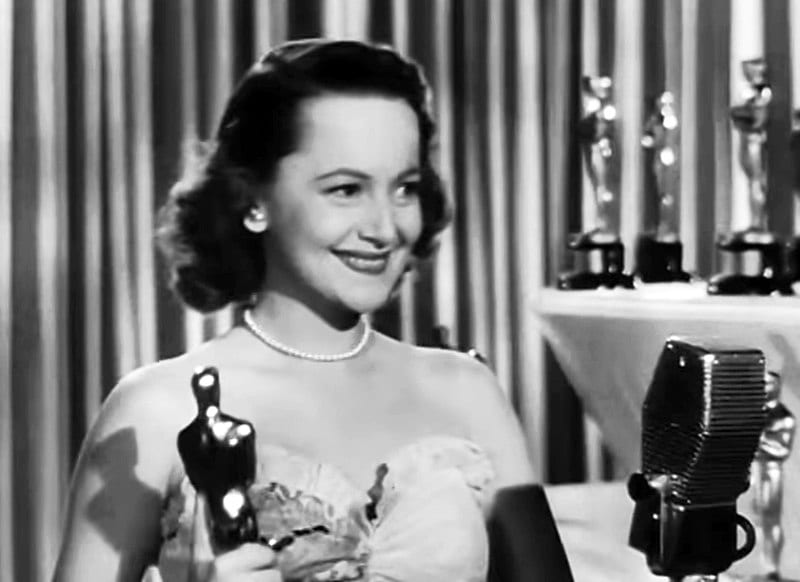
During her career, de Havilland won two Academy Awards (To Each His Own and The Heiress), two Golden Globe Awards (The Heiress and Anastasia: The Mystery of Anna), two New York Film Critics Circle Awards (The Snake Pit and The Heiress), the National Board of Review Award, and the Venice Film Festival Volpi Cup (The Snake Pit), and a Primetime Emmy Award nomination (Anastasia: The Mystery of Anna).
For her contributions to the motion picture industry, de Havilland received a star on the Hollywood Walk of Fame at 6762 Hollywood Boulevard on February 8, 1960.
De Havilland, as a confidante and friend of Bette Davis, is featured in the series Feud: Bette and Joan, portrayed by Catherine Zeta-Jones. In the series, de Havilland reflects on the origins and depth of the Davis–Crawford feud and how it affected contemporary female Hollywood stars. On June 30, 2017, a day before her 101st birthday, she filed a lawsuit against FX Networks and producer Ryan Murphy for inaccurately portraying her and using her likeness without permission. A three-justice panel of the California Court of Appeal of the Second District ruled against the defamation suit brought by De Havilland, a ruling that affirmed the right of filmmakers to embellish the historical record and that such portrayals are protected by the First Amendment. De Havilland appealed the decision to the Supreme Court in September 2018, which declined to review the case.