
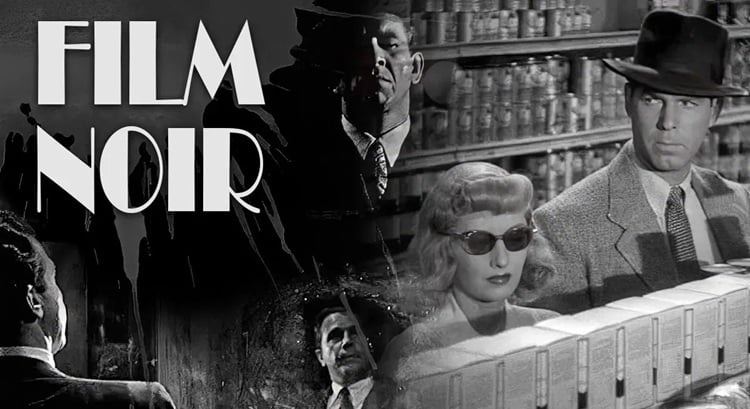
TCM’s Noir Alley is a weekly lineup of film noir classics hosted by Eddie Muller that includes a Val Lewton triple feature on Halloween night, TCM announced.
TCM is showing Film Noir classics on late night Saturdays, introduced by author and film historian Eddie Muller
Every Saturday at midnight, TCM presents Noir Alley, with a classic noir film introduced by Muller (see his video about Film Noir below). Muller keeps a list of the 25 best film noir features of all time, and many will show up in the continuing TCM lineup. You can see Eddie Muller’s list of the 25 best noir films.
The main showing is at midnight Saturdays, with an encore at 10 am Sundays. Read more at: Film Noir on TCM
Noir Alley Schedule
Saturdays at midnight ET, with an encore Sundays at 10 a.m. ET. Click a title or rating to see the movie on IMDB.
- Oct. 10: Crime Wave (1954), IMDB 7.3. A paroled ex-con trying to go straight is dragged back in when his old cellmates turn up on the run. Stars Sterling Hayden and Gene Nelson.
- Oct. 17: Chicago Syndicate (1955), IMDB 6.5. An accountant goes undercover for the FBI to break the Chicago mob’s rackets. Stars Dennis O’Keefe and Abbe Lane.
- Oct. 24: The House on Telegraph Hill (1952), IMDB 6.9. A concentration camp survivor takes a dead friend’s identity to reach America and lands in a San Francisco mansion full of secrets. Stars Valentina Cortese and Richard Basehart.
- Oct. 31: Halloween triple feature
- The Leopard Man (1943), IMDB 6.7. An escaped leopard is blamed for a string of killings that terrorize a New Mexico town.
- The Seventh Victim (1943), IMDB 6.7. A young woman searching for her missing sister in New York uncovers a secret society of devil worshippers. Stars Kim Hunter.
- Cat People (1942), IMDB 7.2. A Serbian immigrant fears she’ll turn into a deadly panther if she gives in to her husband’s love. Stars Simone Simon.
- Nov. 7: Breakdown (1952), IMDB 6.1. A boxer framed for murder gets out of prison, becomes a title contender and tries to clear his name. Stars Ann Richards and William Bishop.
- Nov. 14: Slander (1957), IMDB 6.5. A scandal-magazine publisher threatens to expose a children’s TV star’s past to boost sales. Stars Van Johnson and Ann Blyth.
- Nov. 21: Nora Prentiss (1947), IMDB 7.1. A respectable doctor fakes his own death to run off with a nightclub singer, and his lies spiral out of control. Stars Ann Sheridan.
- Nov. 28: The Great Flamarion (1945), IMDB 6.5. A vaudeville sharpshooter is manipulated into murder by his scheming stage partner. Stars Erich von Stroheim.
- Dec. 6: The Whip Hand (1951), IMDB 6.0. A vacationing reporter uncovers a secret germ-warfare lab hidden at a Minnesota lake.
- Dec. 12 and 19: to be announced
- Dec. 26: Three Strangers (1946), IMDB 6.9. Three strangers share a sweepstakes ticket, and their luck turns deadly. Stars Peter Lorre and Sydney Greenstreet.
More From TCM
- TCM Highlights for October
- TCM Alphabetical List of October Films
- TCM Star of the Month Myrna Loy
- TCM Schedule
- TCM Newsletter Signup
- TCM YouTube Channel
- TCM Facebook Page
Below is a seminar on film noir from TCM’s Eddie Muller.

The Shadowed World of Film Noir
Film noir remains one of cinema’s most enduring and influential movements—a shadow‑drenched realm of moral ambiguity, psychological tension, and visual poetry. Emerging in the early 1940s and flourishing through the 1950s, noir was never a formally declared genre but rather a retrospective label coined by French critics who recognized a shared sensibility in a wave of American crime dramas. These films, marked by stark lighting, cynical heroes, and existential dread, reflected the anxieties of a world reshaped by depression, war, and shifting social norms.
Origins in Expressionism, Poetic Realism, and Hardboiled Fiction
The roots of film noir stretch across continents and artistic traditions. German Expressionism—particularly films like The Cabinet of Dr. Caligari and M—introduced the cinematic language of distorted angles, deep shadows, and psychological unease. Many German filmmakers, fleeing the rise of Nazism, brought these techniques to Hollywood, where they merged with American storytelling traditions.
French Poetic Realism of the 1930s added another layer: stories of doomed characters navigating urban melancholy, often framed with atmospheric lighting and fatalistic tone. Meanwhile, American hardboiled fiction by writers such as Dashiell Hammett and Raymond Chandler provided the narrative backbone—tough detectives, corrupt cities, and moral compromise.
By the early 1940s, these influences converged into a new cinematic style that critics would later call film noir—literally “black film,” a nod to both its visual palette and its thematic darkness.
Visual Style: The Art of Light and Shadow
Film noir’s most recognizable hallmark is its visual design. Low‑key lighting creates sharp contrasts between illumination and darkness, producing the iconic chiaroscuro look. Venetian‑blind shadows slash across characters’ faces; rain‑slicked streets glisten under neon signs; cigarette smoke curls through dimly lit rooms. These images do more than set mood—they externalize the characters’ inner turmoil.
Cinematographers like John Alton, whose work on The Big Combo remains a touchstone, perfected this aesthetic. Noir’s visual world is one where danger lurks in every shadow, and clarity—moral or literal—is always just out of reach.
Themes: Corruption, Fatalism, and the Human Condition
At its core, film noir is a meditation on the darker aspects of human nature. Its protagonists are rarely heroes in the traditional sense. Instead, they are private eyes, war veterans, grifters, or ordinary citizens drawn into webs of deceit. They navigate a world where institutions are corrupt, motives are suspect, and fate seems predetermined.
This fatalism reflects the cultural climate of post‑World War II America. Returning soldiers faced a changed society, economic uncertainty, and the looming specter of the Cold War. Noir captured this disillusionment, offering stories where justice is murky and redemption is rare.
Archetypes: The Antihero and the Femme Fatale
Two figures dominate the noir landscape:
The Antihero
Often a detective or down‑on‑his‑luck everyman, the noir protagonist is flawed, weary, and morally compromised. Humphrey Bogart’s Sam Spade in The Maltese Falcon exemplifies this archetype—sharp‑witted but emotionally guarded, navigating a labyrinth of lies with stoic resolve.
The Femme Fatale
Perhaps noir’s most iconic figure, the femme fatale is intelligent, alluring, and dangerous. She manipulates the hero, not merely out of malice but often from her own desperation or desire for autonomy in a world that restricts her. Barbara Stanwyck’s Phyllis Dietrichson in Double Indemnity remains the definitive example—seductive, calculating, and ultimately tragic.
These archetypes are not clichés but reflections of shifting gender dynamics and societal anxieties in mid‑century America.
Narrative Techniques: Flashbacks, Voice‑Overs, and Twists
Film noir frequently employs unconventional storytelling devices. Flashbacks allow characters to recount their downfall from a point of no return, reinforcing the sense of inevitability. Voice‑over narration—often cynical or world‑weary—draws viewers into the protagonist’s psyche. Twists and double‑crosses abound, mirroring the instability of the noir universe.
Films like Detour (1945) push this structure to extremes, beginning near the story’s end and unraveling the protagonist’s missteps in a spiral of doom.
The Golden Age: 1940s–1950s
The classic period of film noir spans roughly from 1941 to 1958. Early landmarks include:
- The Maltese Falcon (1941)
- This Gun for Hire (1942)
- Laura (1944)
- Murder, My Sweet (1944)
These films established noir’s visual and thematic vocabulary. As the movement matured, directors like Billy Wilder, Otto Preminger, Fritz Lang, and Jules Dassin expanded its boundaries, exploring everything from insurance fraud (Double Indemnity) to police corruption (The Big Heat) to urban procedural realism (The Naked City).
The Role of Women: Power, Constraint, and Subversion
While the femme fatale is the most famous female figure in noir, women in these films occupy a spectrum of roles—from manipulative seductresses to loyal secretaries to victims of circumstance. Their portrayals reflect both the empowerment and the anxieties surrounding women’s changing roles during and after the war.
Noir’s women often challenge traditional gender expectations, even as the narratives sometimes punish them for doing so. This tension remains a subject of ongoing scholarly debate.
Noir’s Legacy: Neo‑Noir and Beyond
Though the classic era ended in the late 1950s, noir’s influence never faded. The 1960s and beyond saw the rise of neo‑noir, a modern reinterpretation that retains noir’s themes while updating its style. Films like Chinatown, Blade Runner, L.A. Confidential, and Drive carry noir’s DNA into new genres and eras.
Noir also shaped the French New Wave, inspired graphic novels, and influenced television, video games, and contemporary crime fiction. Its visual language—rain‑soaked streets, silhouettes, and moral chiaroscuro—remains instantly recognizable.
Why Film Noir Endures
Film noir endures because it speaks to universal human fears: betrayal, corruption, desire, and the struggle to find meaning in a chaotic world. Its stories are intimate yet mythic, grounded yet stylized. Noir invites viewers to peer into the shadows—not to escape reality, but to confront it.
In an age of polished digital imagery and superhero narratives, noir’s gritty realism and emotional complexity feel more relevant than ever. Its influence continues to ripple through cinema, reminding us that the darkest stories often illuminate the most profound truths.
Sources
- What Is Film Noir? A Definition, History, and Impact – TheCollector
- Film Noir History: How Tabloid Journalism Inspired the Genre – TIME
- Film noir: Definition, Movies, & Facts – Britannica
- What is Film Noir: History, Examples, and Style – StudioBinder
- A Beginner’s Guide To Film Noir – Cinema Waves
- Film noir – Wikipedia
- What Is Film Noir? Movies, Directors + Characteristics – Backstage
- A Comprehensive Guide to Film Noir – No Film School
How to Watch TCM
Turner Classic Movies is available on every cable and satellite TV provider, including:
- DirecTV: Channel 256
- Dish: Channel 132
- Spectrum: Channel varies by location; to find yours visit Spectrum Channel Guide
- YouTube TV: Search for TCM
If you have TCM on your cable, you can also stream it free on your smartphone or PC: Streaming TCM
TCM Facebook Page – Latest Posts